Metal Carports That Last Longer Than Your Truck
 Share to X

 12 min read




Table of Contents
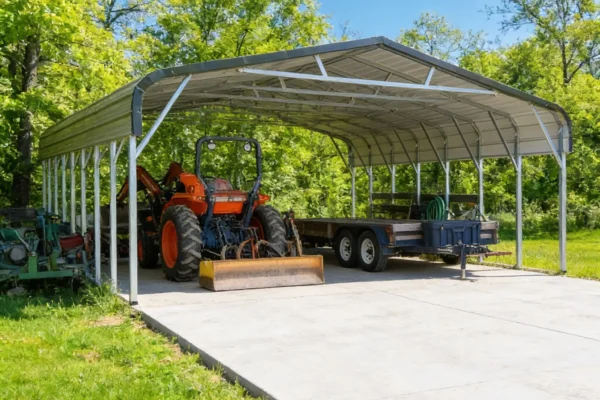
Metal carports use galvanized steel that resists rust, weather, and time. Every Metal America building comes with a workmanship warranty and factory warranties on the panels and framing. Warranty terms depend on your region. A quality metal carport outlives the vehicle it protects, which is exactly what you want when you are spending a few thousand dollars on vehicle protection. The difference between a carport that stands strong for decades and one that crumples in the first serious storm comes down to materials, construction, and proper installation.
You have probably seen the cheap ones from Temu or Amazon. The carports that lean after two years. The ones with rusty legs and panels that flap in the wind. Maybe you even bought one of those and learned the hard way. The good news is that quality metal carports exist, they just require knowing what to look for before you buy.
What Makes Metal Carports Different From Other Shelter Options
Metal carports use galvanized steel frames and panels that last decades with minimal maintenance. Wood structures rot, fabric covers tear, and pole barns need constant upkeep or even pole replacement down the road. Metal just sits there doing its job year after year. The galvanized coating on quality metal carports protects the steel from rust by creating a zinc barrier between the metal and the elements, looking good year after year [1].
Compare that to fabric carports. Those portable canvas covers cost less upfront, usually between $200 and $800. They also last about three to five years before the sun breaks down the fabric and you are buying another one [4].
Wood carports look nice when they are new. Then the termites find them. Or the wood starts rotting where it contacts the ground. You are painting every few years, replacing rotted boards, and hoping the whole thing does not collapse during the next ice storm.
Metal carports handle weather better than alternatives. The galvanized steel coating resists rust even in coastal areas with salt air. The metal panels shed rain and snow immediately instead of absorbing water like wood or sagging under snow weight like fabric.
Standard Metal Carport Sizes That Actually Fit Your Vehicles
The most common mistake people make is buying a metal carport that is too narrow. You measure your vehicle, add a foot on each side, and figure that is enough clearance. Then you spend the next 20 years playing parking lot precision every time you pull in.
Metal carports are sold in 2-foot width increments. The standard widths are 12 feet, 18 feet, 20 feet, 22 feet, and 24 feet. Length typically increases in 5-foot increments for buildings 30 feet wide and under. Height options usually range from 7 feet to 14 feet.
A 12-foot wide carport fits one compact car or a single motorcycle with some storage space. It does not comfortably fit a modern pickup truck. An F-150 SuperCrew with mirrors folded is over 80 inches wide. That leaves you with six inches of clearance on each side in a 12-foot carport. You will scrape something eventually.
For two vehicles, width matters more than length. An 18-foot wide carport fits two compact sedans parked very close together. You cannot open both driver doors at the same time. A 20-foot wide carport fits two mid-size cars or SUVs with reasonable door clearance. This is the minimum width most people should consider for two-vehicle coverage.
If you drive full-size trucks, you need 22 feet minimum for comfortable two-vehicle parking. Better yet, go with 24 feet. Modern trucks are massive. A Ram 2500 with tow mirrors extended is 96 inches wide. Two of those side by side need 16 feet just for the vehicles. Add clearance and you are at 20 feet minimum, and that is tight.
| Vehicle Type | Recommended Width | Why It Matters |
|---|---|---|
| One compact car | 12 feet | Minimum single vehicle coverage |
| One full-size truck | 14-18 feet | Door clearance plus storage |
| Two compact cars | 18-20 feet | Tight fit, limited door clearance |
| Two mid-size vehicles | 20-22 feet | Comfortable parking with door access |
| Two full-size trucks | 24 feet | Proper clearance for modern vehicles |
Length is more forgiving because of how pricing works. Buildings 30 feet wide and under are priced in 5-foot length increments. A 21-foot carport costs the same as a 25-foot carport. Always round up to the next pricing increment if you are considering extra length.
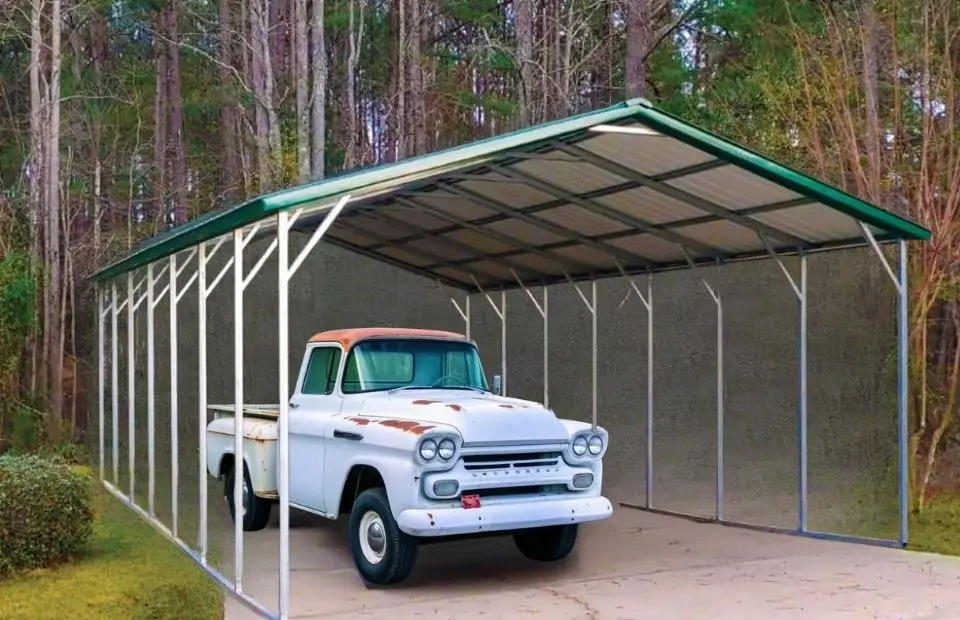
Height depends on what you are covering. Standard passenger vehicles fit fine under 7 or 8 feet. Lifted trucks need 9 or 10 feet. RVs need 12 to 14 feet depending on roof AC units. Measure your tallest vehicle from ground to highest point, then add at least 1 foot of clearance.
The most common size for two-vehicle coverage is 20 feet wide by 20 feet long by 7 or 8 feet tall. This handles two mid-size vehicles with room to open doors and walk between them. It is the sweet spot of coverage and cost for most buyers.
Metal Carport Roof Styles and Why Vertical Beats Horizontal
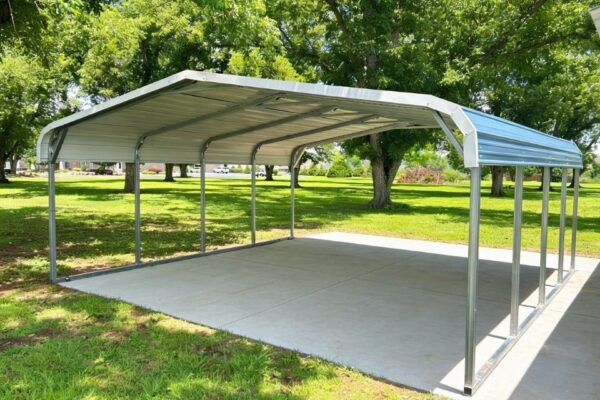
Metal carport roofs come in three main styles, and they are not created equal. Regular horizontal roofs are the cheapest option. A-frame horizontal roofs look better and perform better. Vertical roofs cost the most and last the longest.
Regular horizontal roofs have a rounded edge where the roof meets the walls. The metal panels run horizontally from end to end. This creates little valleys where water, leaves, and debris collect. In a light rain, no problem. In a downpour or snowstorm, those valleys trap moisture. Over time, that moisture finds its way into the panel overlaps and starts rust.
A-frame horizontal roofs have a peaked design with squared-off eaves. The panels still run horizontally, but the framing creates a more finished appearance. Water sheds better than on regular roofs because of the steeper pitch, but you still have the horizontal panel overlap issue.
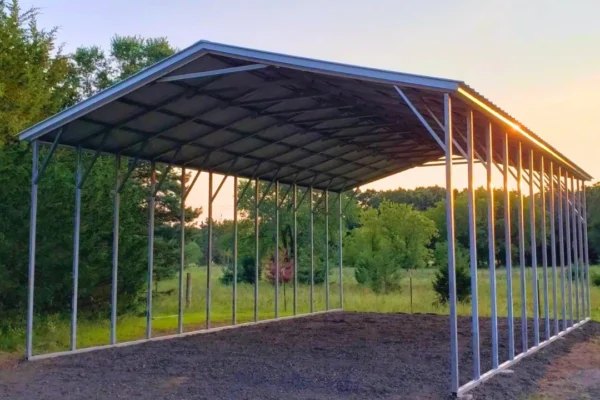
Vertical roofs run the panels from peak to eave instead of end to end. Water and debris run straight down the roof and off the structure immediately. There are no horizontal seams to trap moisture. Leaves slide off instead of piling up. Snow slides off instead of accumulating.
| Roof Style | Water Shedding | Cost | Best Use |
|---|---|---|---|
| Regular Horizontal | Poor | Lowest | Mild climates, budget priority |
| A-Frame Horizontal | Moderate | Medium | Moderate weather |
| Vertical | Excellent | Highest | Any climate with precipitation |
Vertical roofs cost more because they require additional framing. The structure needs hat channels running perpendicular to the trusses to support the vertical panels. The ridge cap at the peak adds material and labor. The result is worth it if you live anywhere with weather.
Buildings longer than 35 feet require vertical roofs regardless of your preference. Metal panels are not manufactured longer than 36 feet for standard gauge options [2]. Vertical roofs eliminate the length limitation because the panels run from peak to eave instead of end to end.
What Your Metal Carport Actually Costs
Metal carport pricing varies by location, but you can expect to pay between $1,800 and $6,000 for most standard two-vehicle configurations. The exact price depends on size, roof style, gauge options, and your specific location.
The most economical option is typically an 18-foot wide by 20-foot long by 7-foot tall regular horizontal roof carport. This runs $1,800 to $2,500 in most markets. It fits two compact cars or one vehicle with storage space.
The most common purchase is a 20-foot by 20-foot by 7-foot or 8-foot carport with an A-frame horizontal or vertical roof. Pricing ranges from $2,200 to $3,500 depending on roof style. This size handles two mid-size vehicles comfortably.
A spacious option like a 24-foot by 25-foot by 8-foot vertical roof carport runs $3,500 to $4,800. This fits two full-size trucks with room to maneuver.
| Common Size | Price Range | What You Get |
|---|---|---|
| 18x20x7 Regular | $1,800-$2,500 | Entry-level two-car |
| 20x20x7 A-Frame | $2,200-$3,200 | Standard two-vehicle |
| 24x25x8 Vertical | $3,500-$4,800 | Full-size trucks |
Price jumps occur at specific width breakpoints. Buildings 12 to 24 feet wide use standard trusses. At 26 feet wide, you need triple-wide trusses, which increases the base price by $800 to $1,200.
Hidden costs to budget for include site preparation if ground needs leveling, ground anchors if not installing on concrete, permit fees if required by local code, and upgrades like 26-gauge panels or 12-gauge framing.
Pricing varies by location, so the ranges given here should be confirmed with local dealers for your specific area.
How Metal Carports Are Anchored So They Stay Put
Metal carports stay in place during storms because of proper anchoring. A properly anchored 20-foot by 20-foot carport survives 140 mile per hour winds [2]. An improperly anchored carport becomes airborne in 60 mile per hour winds. The anchors matter more than the structure itself.
The anchoring method depends on the installation surface. Concrete installations use wedge anchors. Dirt, gravel, or asphalt installations use rebar anchors or mobile home anchors.
Wedge anchors for concrete are expansion-style fasteners. The installer drills through the carport base rail into the concrete, inserts the anchor, and tightens it. As the bolt tightens, a wedge at the bottom expands and locks into the concrete. You need one wedge anchor per post minimum.
| Surface Type | Anchor Type | Anchors Needed | Cost |
|---|---|---|---|
| Concrete | Wedge anchors | 1 per post | Included |
| Dirt/Gravel | Rebar anchors | 1 per 10 feet | $6 each |
| Dirt/Gravel | Mobile home anchors | 1 per 10 feet | $35 each |
Rebar anchors are steel rods that drive into the ground at a 45-degree angle. They bolt to the base rail and transfer uplift forces into the soil. Mobile home anchors include an auger tip that screws into the soil for better holding power in loose or sandy soil.
Calculate the number of anchors by measuring the perimeter of your carport and dividing by 10. A 20-foot by 25-foot carport has a perimeter of 90 feet. Divide by 10 and you need nine anchors minimum.
The site must be cleared and level, with a clear path for delivery. An unlevel installation causes the structure to rack, meaning it twists under load. Installers will refuse to anchor unlevel carports because it voids warranties.
When You Need Permits and When You Do Not
Permit rules depend on your county and HOA. Check with your local building department before you order. In most counties you pull the permit yourself, and every Metal America order includes engineer-stamped drawings for your application.
The only way to know for certain is to call your local building department. Tell them you want to install a metal carport and give them the dimensions. They will tell you what is required.
Every Metal America order includes generic drawings stamped by an engineer licensed in your state, with concrete slab foundation specs. These are pre-designed plans with standard specifications that work for typical projects. Most building departments accept generic drawings for carports in areas with standard wind and snow loads [3].
Site-specific engineered drawings are custom plans tailored to your project’s unique location. If your county requires site-specific drawings, they are priced on your quote.
If your building department says you need permits and drawings, get them before ordering your carport. Installing without the required permits creates problems when you sell the property or file insurance claims.
FAQ Section
Q: How long do metal carports last?
A: Every Metal America building comes with a workmanship warranty and factory warranties on the panels and framing. Warranty terms depend on your region. Galvanized steel resists rust and the structure stays solid through decades of sun, rain, and wind.
Q: What size metal carport do I need for two trucks?
A: Two full-size trucks need at least a 22-foot wide carport. Most people choose 24 feet wide for comfortable door clearance and easier parking.
Q: Do metal carports need to be anchored?
A: Yes, metal carports must be anchored to prevent wind damage. Concrete installations use wedge anchors while ground installations use rebar or mobile home anchors.
Q: Can I install a metal carport myself?
A: Most manufacturers require professional installation to maintain warranties. Professional installation ensures proper anchoring and structural integrity.
Q: Why do vertical roofs cost more than horizontal roofs?
A: Vertical roofs require additional framing components including hat channels and ridge caps. The extra cost provides better water shedding and longer lifespan.
Protecting Your Vehicles Starts With the Right Structure
Metal carports that last decades share three things in common. Galvanized steel frames that resist rust. Proper anchoring that keeps the structure attached to the ground during storms. Sizes that actually fit your vehicles without requiring parking lot precision every single day.
The decision comes down to matching your needs with the right specifications. Width matters more than you think because modern vehicles are wider than ever. Roof style matters if you live anywhere with weather. Anchoring matters everywhere because wind does not care how much you paid for the structure.
Metal America builds carports the right way with 14-gauge galvanized framing, multiple roof style options, and proper engineering for your climate. Our complete guide to metal carport styles and configurations breaks down all 11 standard builds we offer so you can find the exact size and style that fits your situation.
Speedy, Simple, Service. That is what we deliver. You get a carport that protects your vehicles, installed professionally, without complications or drama.
References
[1] American Galvanizers Association. (2024). “Corrosion Protection and Hot-Dip Galvanizing.” https://www.galvanizeit.org/
[2] Metal Building Manufacturers Association. (2024). “Wind and Snow Load Design Standards.” https://www.mbma.com/
[3] International Code Council. (2024). “International Building Code Requirements for Metal Structures.” https://www.iccsafe.org/
[4] U.S. Department of Energy. (2023). “Solar Degradation of Vehicle Paint and Materials.” https://www.energy.gov/
[5] National Association of Home Builders. (2023). “Life Expectancy of Home Components.” https://www.nahb.org/