Carport Buildings That Protect More Than Just Cars
 Share to X

 10 min read




Table of Contents
Carport buildings can protect RVs, boats, farm equipment, outdoor workshops, and living spaces in addition to vehicles. Most people assume a carport is strictly for cars, which leaves them looking at expensive alternatives when they need shelter for oversized toys, equipment, or outdoor areas. You are missing out on serious versatility if you think carport buildings only work for sedans and trucks.
The name “carport” limits how people think about these structures. Modern metal carport buildings handle everything from 40-foot motorhomes to hay storage to backyard workshops. The open design, adjustable height options up to 20 feet, and width flexibility up to 60 feet make carport buildings the Swiss Army knife of property protection.
Why Carport Buildings Work for Almost Any Storage Need
Carport buildings solve diverse storage problems because they start as open frameworks you can customize based on what you need to protect. The base structure provides a roof and vertical support posts without forcing you into enclosed walls or specific layouts.
Height makes the first big difference. Standard residential garages max out at 8 or 9 feet. Carport buildings come in heights from 8 feet to 20 feet. An RV that towers 14 feet tall fits under a properly sized carport. So does a boat on a trailer with the motor trimmed down.
Width creates the second advantage. A standard two-car garage gives you maybe 20 feet of width. Carport buildings scale up to 60 feet wide for commercial applications. Residential carport buildings routinely hit 24 or 30 feet wide. That width accommodates side-by-side storage of a boat and an RV, three vehicles in a row, or one vehicle with a full workshop setup alongside it.
You can start with an open carport and add walls later if your needs change. Partial enclosure on one or two sides blocks prevailing winds without creating an oven in summer. Full enclosure converts the structure into a garage or workshop years down the line. The metal framework stays constant while your usage evolves.
Using Carport Buildings for RV and Motorhome Storage
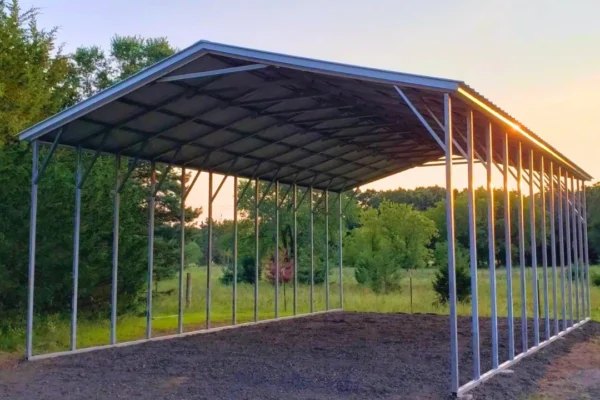
RVs present unique storage challenges that carport buildings solve better than almost any alternative. Class A motorhomes stretch 26 to 45 feet long and stand 12 to 14 feet tall [1]. Most residential garages cannot accommodate those dimensions.
Carport buildings designed for RV storage typically use 12, 14, or 16-foot heights with lengths from 30 to 50 feet. A Class A motorhome needs at least 14 feet of clearance height to account for rooftop air conditioners and satellite equipment [1]. Class C motorhomes require 12 to 14 feet [1]. Travel trailers need 12 feet minimum. Fifth wheels push toward the 14 to 16-foot range. Measure from the ground to the highest point on your RV, including the air conditioning unit, satellite dishes, antennas, and any other roof-mounted equipment.
Width matters as much as height. RVs measure 8 to 10 feet wide at the body, but slideouts add 3 to 4 feet when extended. A 14-foot-wide carport handles most RVs comfortably. Going to 16 feet gives you room to store camping gear or a generator alongside the motorhome.
Storage facility fees run $100 to $300 monthly depending on your market [1]. Over five years, you pay $6,000 to $18,000 to rent a parking spot for an RV you already own. A purpose-built RV carport pays for itself compared to facility fees within just a few years. You also get the convenience of on-property storage.
Consider adding electrical service to your RV carport. A 30-amp or 50-amp outlet lets you run battery maintenance during storage and preheat systems before departure. Some RV owners add partial enclosure on the rear gable end to create protected storage for camping chairs, hoses, and gear.
Carport Buildings for Boat and Watercraft Protection
Boats deteriorate fast when left uncovered. UV radiation fades gelcoat, cracks vinyl seating, and degrades canvas covers. Rain promotes mold growth in carpet and upholstery. Covered storage under a carport building prevents the majority of weather-related damage.
Bass boats on trailers typically stand 8 to 10 feet tall and measure 8 to 9 feet wide [2]. A 12-foot-high by 12-foot-wide carport provides plenty of clearance. Length depends on the boat and trailer combination. A 19-foot bass boat on a standard trailer measures around 24 feet total [2]. Add working space and you want a carport at least 28 to 30 feet long.
Pontoon boats present taller profiles. These boats measure 8 to 12 feet tall when sitting on a bunk trailer with the bimini top in travel position [3]. A 24-foot pontoon often sits on a trailer that measures 33 feet overall with the tongue and motor accounted for [3]. Plan for a carport at least 12 feet tall and 35 feet long if you own a mid-size pontoon. Remove nothing before measuring. Your carport should accommodate your boat exactly as you store it.
Covered boat storage extends hull life significantly compared to outdoor uncovered storage. The shade prevents gelcoat oxidation. The roof blocks rain that seeps into storage compartments and promotes corrosion. You add years of service life to a boat by keeping it under a simple carport roof.
| Boat Type | Typical Height | Width | Recommended Carport |
|---|---|---|---|
| Bass Boat | 8-10 feet | 8-9 feet | 12×30×10 |
| Pontoon Boat | 8-12 feet | 8.5-10 feet | 12×35×12 |
| Jet Ski | 5-6 feet | 4-5 feet | 10×14×8 |
Farm and Ranch Equipment Under Carport Buildings
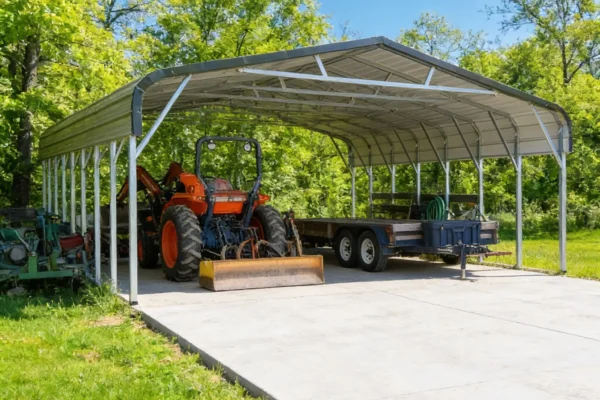
Agricultural equipment benefits enormously from weather protection. Tractors, UTVs, hay bales, and feed all last longer when sheltered from rain, snow, and sun. Carport buildings provide that protection at a fraction of the cost of pole barns or enclosed equipment sheds.
Compact tractors measure 7 to 9 feet tall and need a minimum carport size of 12 feet wide by 20 feet long. Full-size tractors stand 9 to 11 feet tall and require at least 14 feet of width and 25 feet of length. The taller heights account for roll bars and attached implements.
UTVs and side-by-sides measure 6 to 7 feet tall and 6 to 8 feet wide. These vehicles fit easily under standard 8-foot carport heights. Many ranch operators store multiple UTVs side by side under a single wide carport.
Hay storage requires ventilation, which makes the open sides of a carport building perfect. Enclosed barns trap moisture that promotes mold and spoilage. An open carport with just a roof allows air circulation while keeping rain and snow off the bales.
Sizing Carport Buildings for Multiple Uses at Once
Most people want one structure to handle several different storage needs instead of building separate shelters for each item. The key is thinking through how different items can share space efficiently.
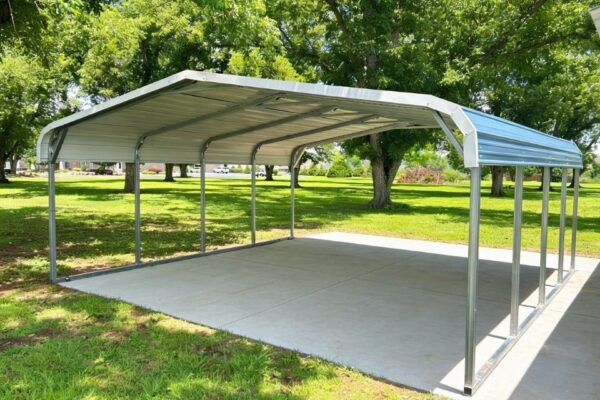
Cars and storage gear work well together in a 24-foot-wide carport. You park the vehicle in one 12-foot section and use the other 12 feet for shelving, tool cabinets, lawn equipment, and seasonal items.
RVs and boats can share a carport if you plan the layout carefully. Storing them end-to-end in a 30-foot-wide by 50-foot-long carport works well. Storing them side-by-side requires more width, usually 24 to 28 feet minimum.
Vehicles and workshop space combine effectively in a 24 to 30-foot-wide carport. Park vehicles on one side and set up a workbench, tool storage, and project area on the other side. Many people discover that a large carport serves them better than a traditional garage because the extra space allows actual work instead of just cramped parking.
Always add 2 to 3 feet of clearance beyond your largest item in every direction. This buffer prevents damage from tight maneuvering and gives you access for maintenance. A carport that barely fits your RV becomes frustrating every time you try to park it.
Think vertically too. The height of your carport determines whether you can add overhead storage racks or shelving above vehicles. A 10-foot carport gives you room to install ceiling-mounted storage for kayaks, lumber, or seasonal items.
What Size Carport Do You Need for Multiple Vehicles?
For two medium-sized vehicles, a 20-foot-wide carport provides adequate coverage. Most people who own trucks, boats, and RVs need at least 24 feet to accommodate two large vehicles with enough clearance to open doors without creating new dents.
| Width | What Actually Fits |
|---|---|
| 18 feet | Two small vehicles (tight squeeze, can fit a small and medium truck) |
| 20 feet | One small and one large vehicle, or two medium-sized vehicles |
| 24 feet | Two large vehicles or two full-sized trucks |
| 30 feet | Two large vehicles or three vehicles total |
Converting Open Carport Buildings Into Enclosed Spaces
Many buyers start with an open carport and add walls later as needs change. This approach saves money upfront while preserving the option to create a fully enclosed garage or workshop down the road.
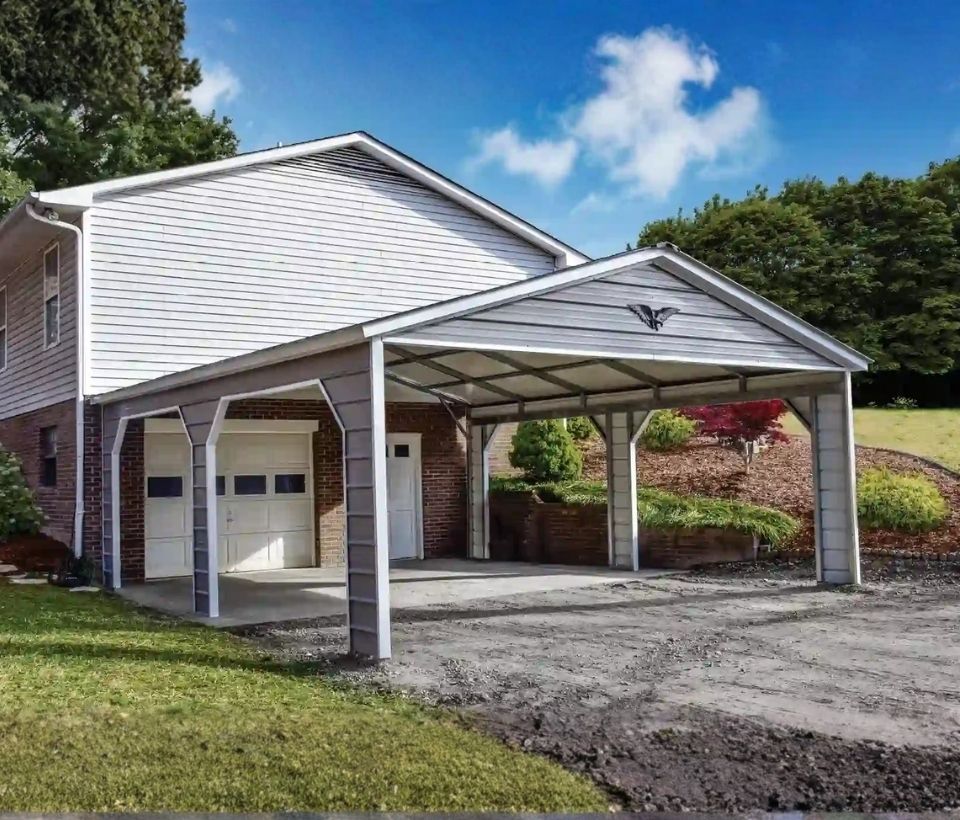
Partial enclosure involves closing one or both gable ends while leaving the sides open. This blocks wind and rain that blow directly into the structure without eliminating airflow. Partial enclosure costs less than full enclosure and often avoids permit complications.
Full enclosure converts your carport into a garage. You add metal panels or insulated walls on all four sides, install doors for access, and potentially add windows for natural light. Full enclosure significantly increases the comfort and security of the space but also increases the investment and may trigger permit requirements.
Check local codes before enclosing a carport. Some jurisdictions treat open carports differently than enclosed garages for zoning, setbacks, and permitting. An open carport might be allowed 5 feet from your property line while an enclosed garage requires 10 feet of setback.
You can enclose a carport years after initial installation. The structure does not care whether you add walls immediately or a decade later. This flexibility means you can build the framework now while budget allows and complete the enclosure when finances improve.
FAQ Section
Q: Can carport buildings be used for RV storage?
A: Yes, carport buildings work excellently for RV storage with heights up to 20 feet available. A typical Class A motorhome needs a 14-foot-wide by 40-foot-long carport with 14 to 16 feet of height for proper clearance.
Q: How do you size a carport building for multiple uses?
A: Add the width needed for each use plus 2 to 3 feet of clearance between items. For example, a car and storage needs 24 feet wide minimum while an RV and boat side-by-side need 24 to 30 feet.
Q: What is the minimum width needed for two full-size trucks?
A: Two full-size trucks require a minimum 24-foot-wide carport to allow comfortable door clearance and parking space. An 18-foot or 20-foot carport will technically fit two trucks, but the tight squeeze makes daily use frustrating and increases the risk of vehicle damage.
Q: Can an open carport building be enclosed later?
A: Yes, carport buildings can be partially or fully enclosed after installation using metal panels, insulated panels, or other materials. Enclosure often changes permit requirements, so check local codes.
Q: What size carport building do I need for a pontoon boat?
A: Most pontoon boats need a carport at least 12 feet tall and 35 feet long to accommodate the boat, trailer, and motor. Width should be 12 to 14 feet for comfortable clearance.
Your Carport Building Can Do More Than You Think
Thinking beyond vehicle storage unlocks the real value in carport buildings. These structures solve storage problems for RVs, boats, equipment, workshops, and outdoor living spaces at costs that beat most alternatives.
Check out our complete guide to metal carport configurations to see standard sizes and options that work for different storage needs. If you are planning to combine a carport with other metal buildings on your property, review our guide to planning multiple structures for layout strategies that maximize space and value.
Metal America delivers carport buildings sized for your specific needs with the flexibility to grow as your requirements change. Speedy, Simple, Service.
References
[1] RV Dimensions Guide, Extra Space Storage, https://www.extraspace.com/blog/self-storage/average-rv-dimensions/
[2] How to Choose the Right Storage Unit Size for Your Boat, RecNation Storage, https://www.recnationstorage.com/blog/how-big-of-a-storage-unit-do-i-need-for-a-boat/
[3] How Tall Is A Pontoon Boat On A Trailer, Life of Sailing, https://www.lifeofsailing.com/blogs/articles/how-tall-pontoon-boat-trailer